 |
|||||||||
|








|
|
|
|
|
|
|
|
|
|
|
|
 |
|||||||||||
|
Click On The Title To See A Larger Image |
|||||||||||
 |
|||||||||||
|
(1934) |
|||||||||||
|
|
|
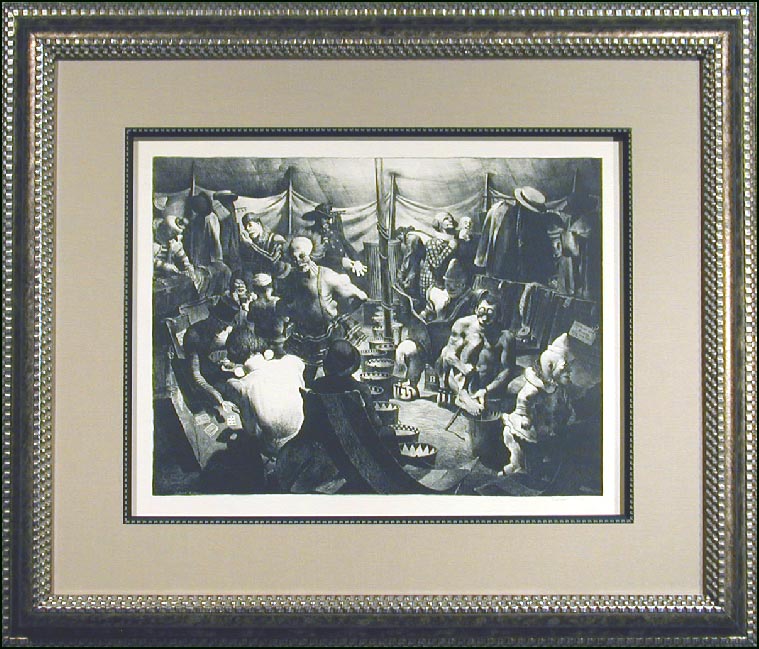
"Clown Alley", 1934, lithograph, 14 3/8" x 19 1/8", signed in the plate, lower left, and in pencil by the artist, lower right, edition of approximately 50, in very good condition [Bassham 39]. As taken from Ben Bassham's "Robert Riggs", Robert Riggs (1897-1970) from the 1920s through the 1940s was a preeminent American graphics illustrator and artist. He produced powerful and richly detailed lithographs in a realistic and unique style portraying societal elements in a profound manner, which brought him success only after he established himself as a prize-winning fine-art lithographer in 1933. He was a consummate graphic artist who composed dramatic and intricately detailed lithographs of life at the margins of American society. Riggs was fascinated by and attracted to people who lived on the edge, and, since childhood, was fascinated by and devoted to the circus, prize-fighting, and those often characterized as disenfranchised. Riggs took up lithography in the depths of the Depression developing his unmistakable style in the early 1930s. His lithographs are characterized by rich, velvety blacks and pebbly gray tones contrasted with harsh highlights. The human form is depicted as hulking, broad-shouldered figures, who play their roles with seriousness. He took great care to insure that every detail was drawn with absolute correctness, and, above all, was interested in people and light. By 1932, Riggs discovered that after drawing with the lithographic crayon and scraping away with razor blades what he did not want, he found that he liked scraped surfaces better than drawn and began to use the razor as a tool for bringing forms out of blackness made by crayon or tusche. In other words, he used a subtractive method working for weeks on a stone and developing the image a square inch at a time. Subtle gradations of tone were created by sanding or rubbing away the grease and the images were developed with short, thin lines having great detail resulting in a stark and gritty style with frequently tragic overtones; sometimes referred to as maniere noire. In 1933, Riggs began a systematic study of the circus, creating prints that clearly show the life of the circus as mysterious and alien with a dreamlike quality; "monsters of preposterousness, glittering, world-renouncing months of unreason, cavorting hybrids, part human and part insane art" (Thomas Mann). "Clown Alley" is circus jargon for the clown's dressing room, specifically, the alley formed of rows of costume trunks and water buckets. There are 19 pages of studies for this print in Riggs' 1934 sketchbook. Reading clockwise from the man tying his shoes at about 1:00, the performers are: unidentified, Arthur Burson (?) in checkered suit, Lou Jacobs washing foot, the dwarf Harry Bedow, Abie Goldstein in bowler, Paul Wenzel in puffed shoulders, Chesty Mortier putting on skirt, Bill Hanlon playing cards, Marco (?) the dwarf in sailor's hat, Charlie Bell rummaging trunk, unidentified man with power puff, unidentified dwarf putting on makeup, and Jim Rutherford in fireman's hat. "Clown Alley" is in a 32 5/8" x 28" swanback frame with checkered rows finished in a deep silver heavily patina'd in smoky black and brown. The wood fillet is in a silver square pattern echoing the checkered frame. The outer khaki linen, middle ivory black beveled accent and inner raised black rag mats are acid and lignin free and protected with Acrylite-AR OP3 (UV) .... $5800.00 (provenance upon request) |