 |
|||||||||
|








|
|
|
|
|
|
|
|
|
|
|
 |
||||||||||
|
Click On The Picture For A Large Image |
||||||||||
 |
||||||||||
|
(c. 1908/1909) |
||||||||||
|
|
|
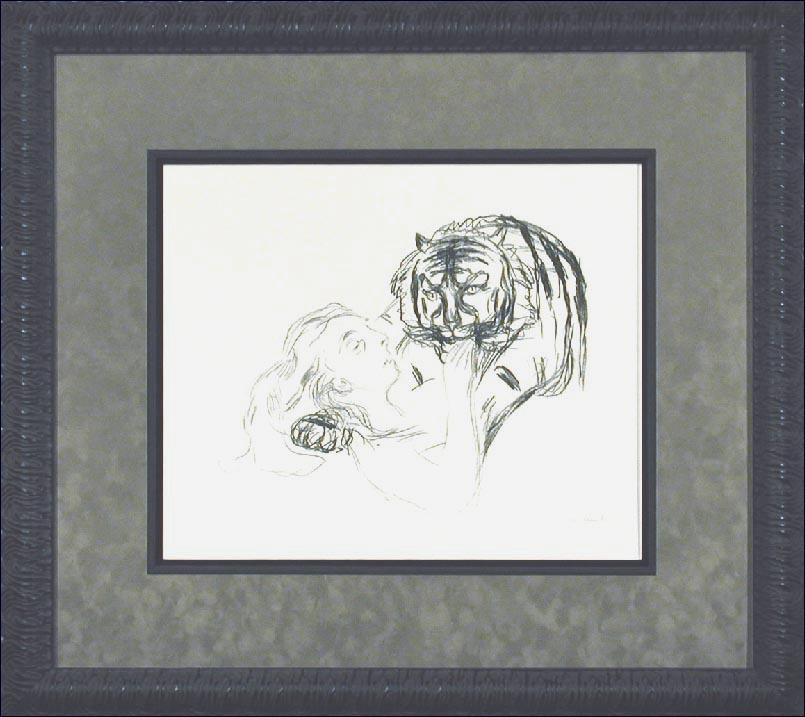
"Omega liebkost den Tiger", [from: Alfa og Omega], (The Tiger), c. 1909, lithograph, by Edvard Munch (1863-1944), 310 x 375 mm., 12 3/8" x 14 ¾", full margins, signed in pencil by the artist, a very good impression of this scarce print (Schiefler 316). Edvard Munch, Norway's greatest artist was an artist of genius and a pioneer of modern Expressionism. His early training was rooted in French romantic realism of the Barbizon school, German lyrical naturalism and Impressionism. Although deeply impressed by Manet, he developed his own approach out of the impressionist and symbolist forms surrounding him. His artistic character was not so much derived from his Norwegian origins, but first by the exciting developments of French art and then by that evolving in Germany at the moment when a new and dynamic art was emerging. He absorbed impressionist, neoimpressionist and other elements, but soon adapted them to intensify psychological content. Edvard Munch was one of the greatest figures in modern printmaking using the mediums to their fullest potential for expression. Like Gauguin, Munch celebrated the raw materials with which prints are made, making these integral to his aesthetic conceptions. As a technical innovator, he was unmatched in his time. He combined lithography and woodcut, adapted a la poupee inking and developed entirely new approaches to the medium. But Munch's works are as fascinating thematically as they are technically. His work is mood-filled and sometimes melancholy suggesting an undefined inward torment. Munch lived to be eighty years old, but the specters of sickness and death hovered over him through much of his life. Many have explored the relationship between Munch's subject matter and his unhappy life, marked by failed love affairs, the deaths of his sister, mother and father, the ideological separation from his intensely Christian family and the frequent hostility of the public. The fears that haunted the artist were frequently given ambiguous but frightening expression in his art. His themes echoed the concerns of many others. Art was Munch's way of coping with the conflicting forces in his world and portraying them symbolically he was thus able to insulate himself against their destructive power. Much of Munch's work centers on the emerging woman theme; a young girl awakens to womanhood in fear and isolation; emotions are conveyed through the extreme reduction of pictorial means and the haunting shapes of the human body. The themes Munch often treated obsessively echo the concerns of many others of his generation. Some have made the observation that the beliefs of Darwin and his German disciple, Ernst Haeckel, in which human beings are determined not only by their physiology but also by their integral relationship to all living and non-living things, are reflected in Munch's imagery. This Edvard Munch lithograph is in a 32 ¼" x 29 7/8" swirled patterned Art Nouveau frame in antique black with a red, brown and gray wash. The beaded wood fillet is antique black with a red, brown and gray wash. The dusk suede outer and coal black deeply rapped beveled suede inner mat are acid and lignin free and are protected with Acrylite-AR OP3 (UV) by CYRO ...$9,200.00 |